


How to Stop Drinking When All Your Friends Drink (Without Losing Your Social Life)

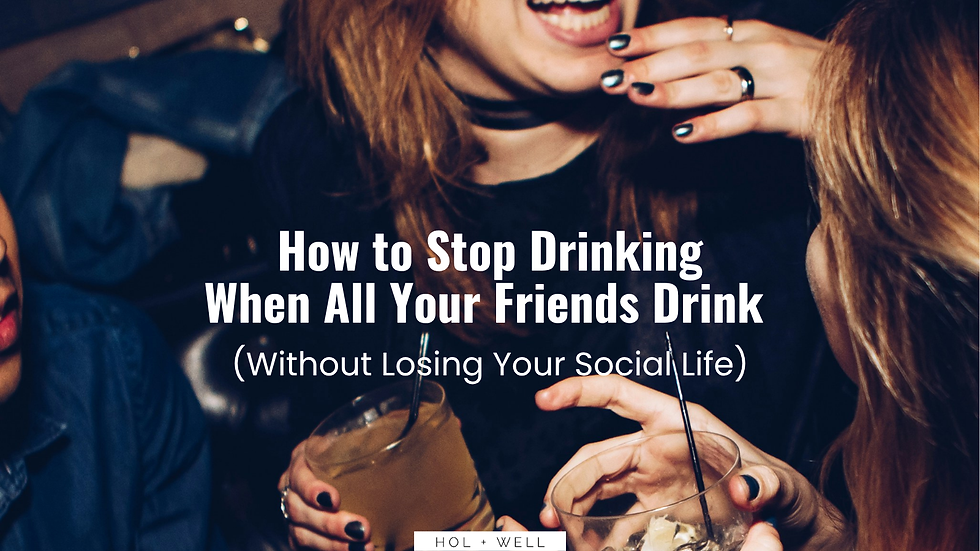
If you’re thinking about quitting drinking, one of the first thoughts that hits is this:
“But all my friends drink.”
And it’s not a small detail.
It’s birthdays, dinners, girls’ nights, patios, vacations, weddings.
It’s connection.
After nearly seven years of sober coaching women, I can say with certainty that the social aspects of changing your relationship with alcohol are often the biggest barriers to change.
So when you start questioning your drinking, it can feel like you’re also questioning your entire social life.
That’s where a lot of women get stuck.
Not because they don’t want to stop drinking. But because they don’t know how to do it without losing people, connection, or belonging.
If you’re trying to figure out how to stop drinking when your friends drink, it can feel like you’re stuck between wanting change and not wanting to lose your social life.
Let’s talk about what’s actually going on here and how to navigate it.
Why This Feels So Hard
This isn’t just about alcohol.
It’s about:
Identity
Belonging
Social norms
Fear of being “different”
Alcohol is often the glue in social environments. It sets the tone, fills silence, softens edges and functions like a social lubricant.
So when you remove it, it can feel like:
You’ll be awkward
You won’t fit in
You won't know how to have fun
You’ll be judged
You’ll lose your place in the group
And if you’ve been the one who:
Always says yes
Keeps the energy going
Drinks to connect or relax
Then this shift can feel big.
But here’s the part that matters:
The discomfort you’re anticipating isn’t a sign you shouldn’t change. It’s a sign you’re stepping outside of something that’s been normalized both individually and at a societal level, likely for a long time.
The Truth Most People Don’t Say
You don’t actually need everyone else to change.
But you do need a plan.
Because if you walk into the same environments, with the same people, under the same conditions and just “try harder” not to drink?
You’ll end up right back where you started.
Hoping for the best is not a good strategy.
This is why moderation often feels impossible and if that’s been your experience, you’re not alone: I break that down more deeply in Why Can’t I Moderate Alcohol? The Real Reasons Moderation Feels Impossible.
Step 1: Get Honest About Your Patterns
Before you try to “handle” social situations, you need clarity.
Ask yourself:
When do I usually drink socially?
Who do I drink the most with?
What am I actually getting from drinking in those moments?
Is it:
Relief after a long day?
Less social anxiety?
A way to feel included?
Because the goal isn’t just to remove alcohol.
It’s to understand what role it’s been playing.
If you haven’t already, this is a good place to start 👉 Am I Drinking Too Much? Signs Alcohol May Be Quietly Becoming a Problem
Step 2: Stop Going In Unprepared
This is where most women trip themselves up.
They decide they’re “not drinking tonight" and then show up to a dinner where everyone orders wine and suddenly they’re negotiating with themselves.
That’s not a willpower issue. That’s a strategy issue.
Instead, go in with:
A clear decision ahead of time
Accountability with others by sharing your plan
A drink alternative already chosen
A simple response if someone asks
Examples:
“I’m not drinking tonight”
“I’m taking a break from alcohol”
“I feel better without it”
You don’t owe anyone a long explanation.
If this is the part where things usually fall apart for you:
If you’ve tried to “just not drink” in social situations and it hasn’t worked, it’s not because you lack discipline.
It’s because you’ve been going into high-trigger environments without a strategy that actually supports you.
This is exactly the kind of work I do with clients. I help women build a plan so they can navigate dinners, events, and weekends without white-knuckling their way through them.
If you’re ready for that level of support, you can learn more about private coaching here.
Step 3: Expect Some Discomfort (and Don’t Panic When It Happens)
You might feel:
A little out of place
More aware
Less “loosened up” than you normally feel while drinking
That’s normal.
It doesn’t mean:
You’re doing it wrong
You don’t belong
You need a drink
It means your brain is adjusting.
And over time, something surprising happens:
You start to realize how much of the connection was never about alcohol in the first place.
Step 4: Pay Attention to Who Supports You (and Who Doesn’t)
This part can be uncomfortable and it’s important.
Some people will:
Respect your choice
Not make it a big deal
Support you, even if they don’t fully understand
Others might:
Push or encourage you to drink
Make jokes
Act uncomfortable
That’s not about you.
That’s about their relationship with alcohol.
You don’t need to cut everyone off. But you do need to notice where you feel:
Safe
Respected
Pressured
Because those environments will either support your change or quietly work against it. Pro tip: boundaries are your best friend here.
Step 5: Build a Life That Isn’t Built Around Drinking
If your entire social life revolves around alcohol, it will feel like everything is at risk.
So the work becomes:
Expanding your routines
Exploring new ways to socialize and have fun
Creating new ways to connect
Finding spaces where alcohol isn’t the centre
This doesn’t happen overnight.
But it does happen.
And it’s one of the most meaningful parts of the process.
If you’re early in this process, this will also help 👉 The First 90 Days of Sobriety: What to Expect (and How to Stay Consistent
A Quick Reality Check
You don’t have to:
Lose your friends
Stop being social
Become a completely different person
But you may:
Outgrow certain dynamics
Shift how, where and with whom you spend your time
Redefine what connection looks like
And that’s not a loss.
That’s alignment.
If You’re Ready to Actually Change This Pattern
If you’ve been trying to navigate this on your own and keep ending up in the same cycle, it’s not a lack of effort.
It’s that you’re trying to change something deeply ingrained without the structure, support, and strategy to back it up.
Inside private coaching, we:
Build a plan for real-life situations (not ideal scenarios)
Work through the patterns that keep pulling you back
Help you follow through in a way that actually sticks
If you’re ready for that level of support:
👉 Apply for private coaching here: https://www.holandwell.com/the-freedom-method
If you’re not quite ready for private coaching but want support and community, you can learn more about The Well Circle here: https://www.holandwell.com/well-circle
FAQ: Stopping Drinking When Your Friends Drink
How do I say no to alcohol without it being awkward?
Keep it simple and neutral. Most people take their cue from how you say it. A confident, low-key response goes a long way.
What if my friends pressure me to drink?
That’s useful information. It tells you something about the dynamic. You don’t need to argue - just hold your boundary and observe.
Will I lose friends if I stop drinking?
You might experience shifts. But the relationships grounded in real connection tend to stay and often deepen. And the dynamics held together by alcohol? They may fade away but that also creates space for new, more aligned dynamics to develop.
What if I feel boring without alcohol?
That’s a common fear. It’s not reality, it’s a learned association. Give it time and your confidence will recalibrate.
The Bottom Line
Quitting drinking when all your friends drink isn’t just about saying no to alcohol.
It’s about:
Learning to tolerate discomfort
Building new patterns
Staying connected to what you actually want
You don’t need to isolate yourself to change your relationship with alcohol.
But you do need intention, awareness, and support.
And once you have that, this becomes a lot more doable than it feels right now.
Cheering you on, always 🫶🏼


Comments